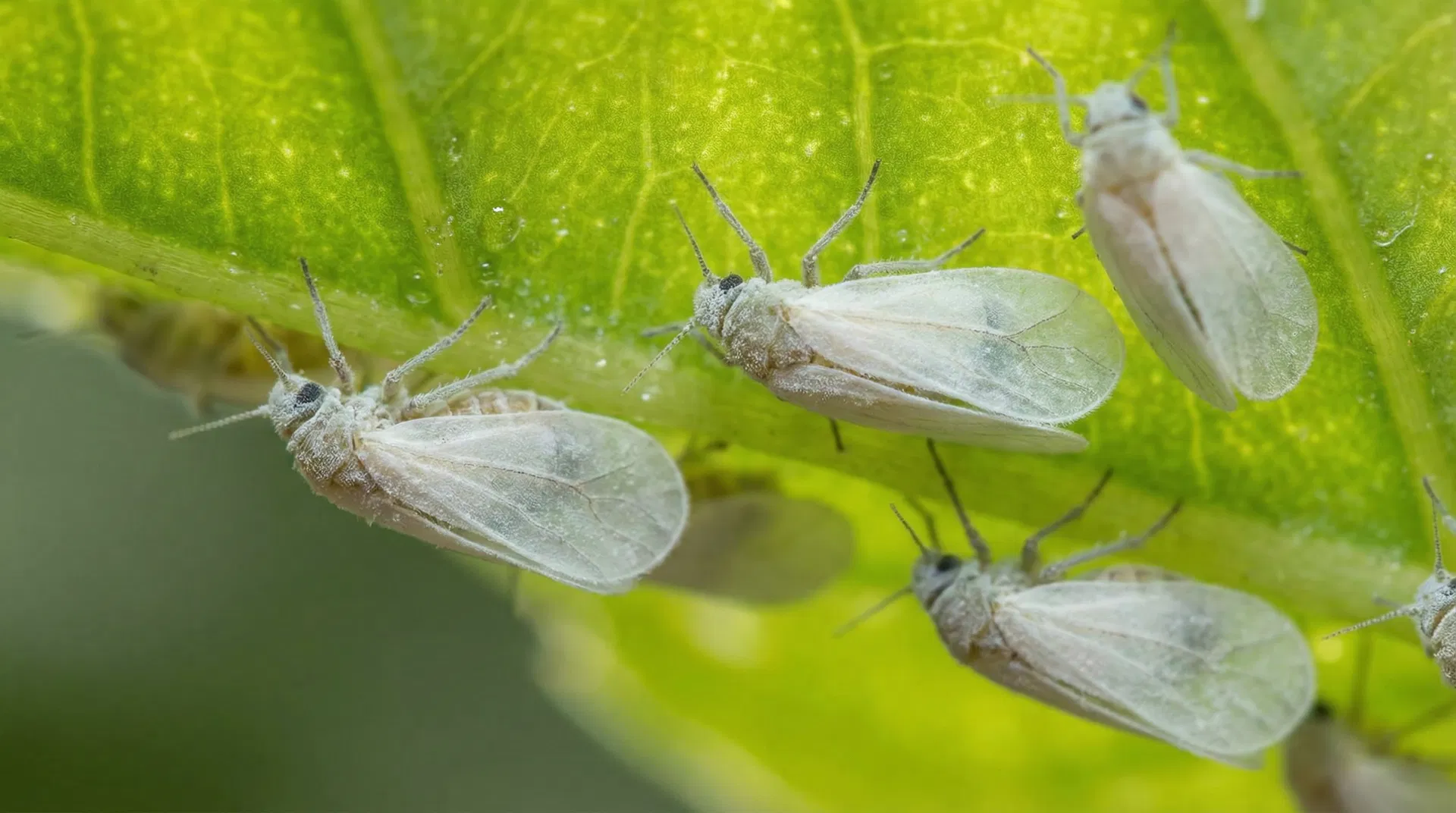
Whiteflies in South Florida: Complete Guide to Identification, Damage and Control
Learn about the 4 most destructive species in Miami, how to identify an infestation before it destroys your garden, and the most effective treatment methods.
Whiteflies are one of the most devastating pests for gardens, landscaping, and crops in South Florida. Despite their small size (1-3 mm), these insects can completely destroy ornamental plants, hedges, shade trees, and crops within weeks. Miami-Dade County is considered one of the world's epicenters of whiteflies, with several invasive species that have established themselves in the region and have no effective natural control.
What makes whiteflies especially destructive is their combination of explosive reproduction, ability to transmit plant viruses, and the resistance they quickly develop to insecticides. A single female can lay between 200 and 400 eggs during her lifetime. In Miami's subtropical climate, with warm temperatures year-round, the complete life cycle can be completed in just 3-4 weeks, allowing an infestation to go from a few insects to millions in a month.
South Florida harbors several whitefly species, but the most destructive are the ficus whitefly (Singhiella simplex), the spiraling whitefly (Aleurodicus dispersus), the palm whitefly (Aleurodicus cocois), and the tobacco whitefly (Bemisia tabaci). Each species attacks specific plants and requires a different control approach.
The 4 Most Destructive Species in Miami and South Florida
1. Ficus Whitefly
Singhiella simplex
Size
Adults: 1–1.5 mm; Eggs: 0.2 mm
Color
Adults: pure white with white wings; Nymphs: pale yellow to green
Habitat
Ficus benjamina, Ficus microcarpa, other ornamental ficus
Introduced to Miami in 2007, this species quickly became the most devastating pest of ficus hedges in South Florida. It can completely kill a ficus within 6-12 months if untreated. Nymphs and adults feed on the underside of leaves, sucking sap and causing massive defoliation. The infestation begins with yellowing leaves and premature leaf drop, progressing to complete plant death. It is responsible for the death of millions of ficus hedges in Miami-Dade and Broward County. It has multiple generations per year and can rapidly develop resistance to insecticides.
Tip: If you have ficus hedges on your property, inspect them monthly. Turn the leaves over and look for small white spots (adults) or yellow scales (nymphs) on the underside. Early detection can save the hedge.
2. Spiraling Whitefly
Aleurodicus dispersus
Size
Adults: 2–3 mm; Eggs: arranged in characteristic spiral
Color
Adults: white with gray wing spots; Eggs: white in spiral pattern
Habitat
Over 250 plant species: palms, hibiscus, avocados, guavas, ornamentals
The whitefly species with the widest host range in South Florida: it can attack more than 250 different plant species. It is easily identified by the spiral pattern that the eggs form on the underside of leaves. Adults are larger than other species and produce large amounts of white wax and honeydew. The honeydew covers leaves and promotes the growth of sooty mold (black soot), which blocks photosynthesis. It can cause the death of ornamental palms, fruit trees, and garden plants in severe infestations.
Tip: If you see leaves covered with white waxy powder and sticky black soot, with small white spirals on the underside, you have spiraling whitefly. It is especially common on hibiscus, avocados, and palms.
3. Palm Whitefly
Aleurodicus cocois
Size
Adults: 2–2.5 mm
Color
Adults: creamy white; Nymphs: yellow-green with white waxy secretions
Habitat
Palms (especially Sabal palmetto, Washingtonia), bananas, coconuts
A species specialized in palms and tropical plants, very common in South Florida given the abundance of palm trees in the region. It produces large amounts of white wax that completely covers the leaves, giving them a floury appearance. Severe infestations can cause the death of young ornamental palms and significantly weaken adult ones. It is especially problematic in properties with collections of high-value ornamental palms.
Tip: Palms with leaves that appear covered in white flour or with black soot on lower leaves probably have palm whitefly. Systemic treatment (soil injection) is most effective for palms.
4. Tobacco Whitefly (Crop Whitefly)
Bemisia tabaci
Size
Adults: 1–1.5 mm; very small
Color
Adults: yellowish white; Nymphs: pale yellow, almost transparent
Habitat
Tomatoes, peppers, cucumbers, melons, poinsettias, indoor and outdoor ornamentals
The most economically important whitefly species worldwide. In South Florida it primarily affects home gardens, vegetable crops, and ornamental plants. Its main danger is not just the direct feeding damage, but its ability to transmit more than 100 plant viruses, including the Tomato Yellow Leaf Curl Virus (TYLCV), which can completely destroy a tomato garden. It develops resistance to insecticides very quickly, complicating control.
Tip: If you grow tomatoes, peppers, or cucumbers in your garden and the leaves turn yellow and curl upward, you likely have tobacco whitefly transmitting viruses. Act immediately before the virus spreads to all plants.
Why South Florida is the Whitefly Epicenter
South Florida brings together all the conditions that favor whitefly population explosions: constant heat, high humidity, absence of winters that reduce populations, and an extraordinary diversity of host plants. Temperatures that rarely drop below 60°F allow whiteflies to complete their life cycle in just 3-4 weeks year-round, without seasonal interruptions.
The biodiversity of South Florida's tropical landscaping provides an almost unlimited variety of host plants. Miami gardens typically contain ficus, palms, hibiscus, ixoras, gardenias, and dozens of other ornamental species, all susceptible to different whitefly species. This diversity of hosts allows multiple whitefly species to coexist on the same property.
The absence of effective natural enemies is another critical factor. Many of the most destructive whitefly species in South Florida are invasive (such as the ficus whitefly, introduced from Asia), and have no established natural predators in the region. This allows them to reproduce unchecked until they reach devastating infestation levels.
Whitefly Damage: Beyond Yellow Leaves
Death of Ornamental Plants
The ficus whitefly can completely kill a ficus hedge in 6-12 months. Severe infestations of any species can cause the death of ornamental shrubs, shade trees, and palms. The loss of mature plants represents significant economic losses and years of replacement.
Sooty Mold (Black Soot)
The honeydew excreted by whiteflies covers leaves, branches, and nearby surfaces with a sticky layer. Sooty mold, a black fungus, grows on this honeydew. It covers leaves, branches, and nearby surfaces (garden furniture, floors, walls). It is an indicator of active and significant infestation.
Plant Virus Transmission
The tobacco whitefly (Bemisia tabaci) is a vector for more than 100 plant viruses. Tomato Yellow Leaf Curl Virus can completely destroy a tomato garden in weeks. These viruses have no cure: once infected, the plant must be removed to prevent spread.
Loss of Landscaping Value
A well-established garden or landscaping can represent between 10% and 20% of a property's value. The death of hedges, shade trees, and ornamental plants from whiteflies can significantly reduce the value and visual appeal of the property.
6 Whitefly Infestation Signs You Should Not Ignore
Cloud of white insects when shaking the plant
The most characteristic sign: when shaking or touching an infested plant, a cloud of small white insects briefly flies before settling again. If this happens, the infestation is already significant.
White spots or scales on the underside of leaves
Whitefly nymphs and pupae attach to the underside of leaves and look like small white or yellowish scales. In the case of the spiraling whitefly, the eggs form a characteristic spiral pattern.
Yellowing leaves and premature drop
Infested leaves lose their green color, turn yellow or pale, and fall prematurely. In ficus, defoliation can be massive and rapid. The plant looks stressed even with adequate watering and fertilization.
Sticky black soot on leaves and surfaces
Sooty mold (black fungus) grows on the honeydew excreted by whiteflies. It covers leaves, branches, and nearby surfaces (garden furniture, floors, walls). It is an indicator of active and significant infestation.
White waxy powder on leaves
Some species (especially the spiraling whitefly and palm whitefly) produce large amounts of white wax that covers leaves, giving them a floury or snowy appearance. It is especially visible on palms and hibiscus.
Stunted growth and leaf deformation
Young infested plants show stunted growth, deformed leaves, and weak new shoots. In the case of virus infestation (transmitted by Bemisia tabaci), leaves curl upward and show yellow mosaics.
Control Methods and 13 Prevention Tips
Whitefly control requires an integrated approach combining multiple methods. No single method is sufficient to eliminate an established infestation, especially in South Florida where conditions favor continuous reproduction.
Monitoring and Early Detection
- ✓
Inspect the underside of leaves on your plants monthly, especially ficus, hibiscus, palms, and tomatoes. Early detection is the key to effective control.
- ✓
Install yellow sticky traps near susceptible plants. Whiteflies are attracted to yellow color and traps allow detecting infestations before they become visible.
- ✓
Check new plants before introducing them to your garden. Whiteflies spread easily through infested plants purchased from nurseries.
Physical and Cultural Control
- ✓
Remove and dispose in sealed bags heavily infested leaves. Do not compost them: eggs and nymphs can survive in compost.
- ✓
Wash plants with a strong stream of water to physically remove adults and nymphs. Do it early in the morning so leaves dry during the day.
- ✓
Keep plants healthy with adequate watering and fertilization. Stressed plants are more susceptible to severe infestations.
- ✓
Avoid excessive nitrogen fertilization: it promotes the growth of tender leaves that are the preferred food of whiteflies.
Biological and Organic Control
- ✓
Apply neem oil diluted at 2% on the underside of leaves. It is effective against nymphs and adults and does not harm beneficial insects when applied correctly.
- ✓
Use insecticidal soap on the underside of leaves. It kills on contact and leaves no toxic residues. Requires repeated applications every 5-7 days.
- ✓
Encourage natural predators like Encarsia formosa (parasitic wasp) and Delphastus catalinae (predatory beetle) by avoiding broad-spectrum insecticides.
Professional Treatment
- ✓
For severe infestations in large trees and hedges, systemic treatment (imidacloprid applied to soil or injected into trunk) is most effective. The insecticide is absorbed by the plant and kills insects when they feed.
- ✓
Treatment with horticultural oils at commercial concentrations covers all life cycle stages and is more effective than over-the-counter products.
- ✓
A professional treatment program with visits every 4-6 weeks during the active season is the most effective way to control whiteflies on properties with extensive landscaping.
When to Call a Professional?
Home methods can be effective for mild infestations on individual plants, but have important limitations: over-the-counter products have low concentrations, manual coverage of large plants is incomplete, and without a follow-up program, populations recover quickly.
Call a professional immediately if:
- •You have ficus hedges showing defoliation or yellowing
- •The infestation affects multiple plants or large trees
- •You have applied home products without results in 2 weeks
- •Plants show virus symptoms (curled leaves, yellow mosaics)
- •You have high-value ornamental palms with infestation symptoms
- •Black soot covers large areas of your garden or outdoor spaces
Professional treatments include: systemic imidacloprid soil applications (effective for 3-6 months), foliar treatments with horticultural oils and insect growth regulators, integrated management programs with follow-up visits, and specific recommendations for each plant and whitefly species. A certified professional can identify the exact species and design the most effective treatment program for your property.
Do You Have Whiteflies in Your Garden?
At Harpoon Pro Pest Control we offer free whitefly inspections in Miami and South Florida. Our certified technicians will identify the species, assess the infestation level, and present you with the most effective treatment plan to protect your garden and landscaping.