
Organic Fertilization in South Florida: The Eco-Friendly Alternative for a Healthy Garden
Discover how to nourish your lawn, ornamental plants, and palms naturally, respecting Miami's coastal ecosystem and complying with Florida's environmental ordinances.
Organic fertilization is not just a trend — in South Florida, it's an ecological necessity. The coral reefs of the Florida Keys, Biscayne Bay, Florida Bay, and the Everglades are unique ecosystems being directly threatened by synthetic fertilizer runoff. The nitrogen and phosphorus that leach from residential gardens feed the algae that suffocate corals and destroy marine life.
South Florida's fertilizer ordinances (Miami-Dade, Broward, Palm Beach) that prohibit the application of nitrogen and phosphorus fertilizers between June and September were born precisely from this environmental crisis. Certified organic fertilizers, however, are exempt from these restrictions in most counties, making them the only legal option during the rainy season.
But beyond legality, organic fertilizers offer benefits that synthetic ones cannot match: they improve Miami's sandy soil structure, stimulate beneficial microbial activity, release nutrients slowly without burn risk, and build a soil ecosystem that becomes more self-sufficient over time.
Why Choose Organic Fertilization in South Florida?
Exempt from the Fertilizer Ordinance
Certified organic fertilizers (with OMRI seal or equivalent) are exempt from the June-to-September prohibition in most South Florida counties. You can fertilize year-round without violating the law.
Improves Miami's Sandy Soil
Compost, worm castings, and organic fertilizers add organic matter to sandy soil, improving its water and nutrient retention capacity. Over time, the soil becomes more fertile and less dependent on frequent fertilizations.
Protects Aquatic Ecosystems
Organic fertilizers release nutrients slowly and bind to soil organic matter, drastically reducing runoff into canals, bays, and the ocean. They're the responsible choice for waterfront properties.
Stimulates Soil Microbial Life
Organic fertilizers feed bacteria, mycorrhizal fungi, and other beneficial microorganisms that decompose organic matter, fix atmospheric nitrogen, and make soil nutrients more accessible to roots.
Safe for Children, Pets, and Wildlife
No synthetic chemicals that could irritate skin, contaminate pets' drinking water, or harm beneficial birds and insects like bees and butterflies.
The Best Organic Fertilizers for South Florida
Compost
NPK
Variable (0.5-0.5-0.5 to 2-1-1)
Source
Vegetable scraps, leaves, cut grass
Improves soil structure, increases water retention, provides beneficial microorganisms. The best soil conditioner available.
Application
Apply 2–3 inches as top dressing on lawn or mix 30% compost with soil when planting. Repeat every 3–4 months.
Tip: Spent mushroom compost is especially valuable in South Florida for its high calcium content, which helps neutralize excessive acidity in organic soils.
Worm Castings (Vermicompost)
NPK
1-0-0 to 3-1-1
Source
Red worm excrement (Eisenia fetida)
The most complete organic fertilizer available. Contains plant growth hormones, enzymes, beneficial microorganisms, and nutrients in bioavailable form. Stimulates germination and rooting.
Application
Apply 1/4 to 1/2 inch around plants or mix 10–20% with substrate. For worm tea: soak 1 cup in 1 gallon of water for 24 hours and apply as liquid fertilizer.
Tip: Worm tea is excellent to apply during the blackout period — it contains no synthetic nitrogen and is exempt from the ordinance. Apply every 2 weeks in summer.
Blood Meal
NPK
12-0-0
Source
Livestock processing byproduct
Fast-release nitrogen source for plants needing an immediate boost. Slightly acidifies soil, beneficial for azaleas and gardenias.
Application
Apply 1–2 pounds per 100 square feet. Mix lightly with soil and water well. Avoid direct contact with roots and trunks.
Tip: Use sparingly — excess can burn plants. Ideal for quickly correcting nitrogen deficiencies in plants with general yellowing.
Bone Meal
NPK
3-15-0
Source
Steam-processed livestock bones
Slow-release phosphorus source to stimulate root development and blooming. Especially useful when transplanting or planting new shrubs.
Application
Apply 1–2 pounds per 100 square feet or mix 1 tablespoon per gallon of substrate when planting. Effect lasts 3–4 months.
Tip: Although it contains phosphorus, organic bone meal is exempt from Florida's fertilizer ordinance because its release is so slow it poses no runoff risk.
Kelp Meal
NPK
1-0.1-2
Source
Dried and ground seaweed
Rich in micronutrients, growth hormones (cytokinins, auxins), and trace elements. Improves resistance to water and heat stress — crucial during Miami summers.
Application
Apply 1 pound per 100 square feet every 2–3 months. Also available in liquid form for foliar application.
Tip: Liquid kelp extract is one of the best organic foliar fertilizers. Apply in the early morning to maximize absorption.
Liquid Worm Compost + Molasses
NPK
Variable
Source
Worm tea activated with cane molasses
Cane molasses feeds the beneficial bacteria in worm tea, creating a living biofertilizer that colonizes the soil with beneficial microorganisms.
Application
Mix 1 gallon of worm tea with 1 tablespoon of unsulfured molasses. Apply immediately (the living product doesn't store). Water the soil or apply foliarly.
Tip: This mix is especially effective after applying fungicides or pesticides that have damaged soil microbiota. Restores microbial life in 2–4 weeks.
Bat Guano
NPK
10-3-1 (high nitrogen) or 3-10-1 (high phosphorus)
Source
Bat excrement (guano phosphorite)
High-concentration organic fertilizer with moderate release. High-nitrogen guano stimulates foliar growth; high-phosphorus guano promotes blooming and root development.
Application
Apply 2–5 pounds per 100 square feet. Mix with soil or apply as top dressing. Water well after application.
Tip: Bat guano is one of the few organic fertilizers with enough nitrogen concentration to effectively replace synthetic fertilizers on lawns.
Organic Potassium Sulfate (Langbeinite)
NPK
0-0-22 + 11% Mg + 22% S
Source
Natural mineral (K-Mag, Sulfate of Potash Magnesia)
Certified organic source of potassium and magnesium — the two most deficient nutrients in South Florida palms. Water-soluble but with moderate release.
Application
Apply 1–2 pounds per 100 square feet for palms and plants with potassium or magnesium deficiency. Can be applied during the blackout period.
Tip: Langbeinite (K-Mag) is the organic alternative to the synthetic potassium sulfate recommended by UF/IFAS for palms. Combine with compost to maximize absorption.
Organic Fertilization Program by Plant Type
St. Augustine and Bahia Lawn
- ✓January–February: Apply compost (2-inch top dressing) + monthly worm tea
- ✓March–May: Bat guano (high N) + kelp meal. Apply compost if not done in winter.
- ✓June–September (blackout period): Worm tea every 2 weeks + liquid kelp extract. Apply compost in August.
- ✓October–November: Bat guano + kelp meal + compost
- ✓December: Compost + monthly worm tea
Tip: Organic lawn takes 2–3 seasons to reach its full potential. Patience is key — the soil gradually enriches with each application.
Palms
- ✓January: Compost (3 inches under canopy) + langbeinite (K-Mag) for potassium and magnesium
- ✓April: Bat guano (high N) + langbeinite + kelp meal
- ✓July: Compost + langbeinite + worm tea (during blackout period)
- ✓October: Bat guano + langbeinite + kelp meal
Tip: For palms with severe potassium or manganese deficiencies, organic fertilizers alone may not be sufficient. Consult a professional about whether chelated mineral supplements are needed.
Flowering Shrubs (Hibiscus, Bougainvillea, Ixora)
- ✓Every 2 months (year-round): Compost + liquid kelp meal
- ✓Spring and fall: Bat guano (high P for blooming) + langbeinite
- ✓Monthly (summer): Worm tea + foliar kelp extract
Tip: To maximize blooming organically, apply liquid kelp extract every 2 weeks during the blooming season. The natural cytokinins in seaweed stimulate flower bud formation.
Indoor and Shade Plants
- ✓Every 3 months: Worm castings (mix 10% with substrate)
- ✓Monthly: Diluted worm tea (1:10 with water)
- ✓Spring: Liquid kelp meal to stimulate new growth
Tip: For potted plants, worm castings are the ideal organic fertilizer — no odor, won't burn roots, and releases nutrients gradually with each watering.
Composting in South Florida: Practical Guide
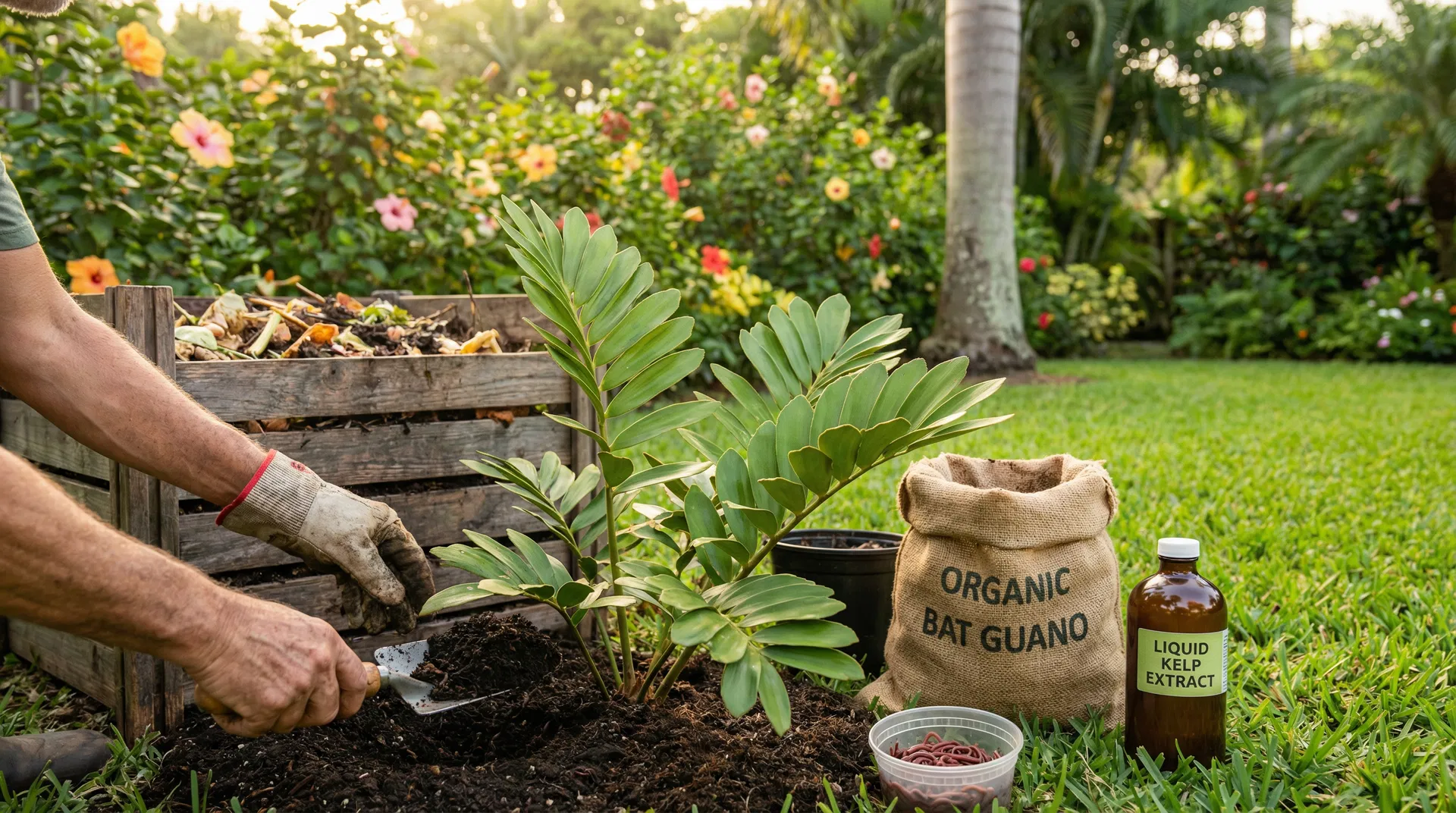
Applying compost and organic fertilizers in a South Florida tropical garden — bat guano, kelp extract, and red worms.
Composting in Miami has its particularities. Heat and humidity accelerate decomposition (what takes 6 months in the north takes 6–8 weeks here), but also favor insect proliferation and odors if not managed correctly.
To compost successfully in South Florida, you need to balance "brown" materials (carbon-rich: dry leaves, cardboard, paper) with "green" materials (nitrogen-rich: fruit and vegetable scraps, cut grass, coffee grounds). The ideal ratio is 3 parts browns to 1 part greens.
🌿 Use a closed composter
In Miami, an open composter can attract cockroaches, rats, and other animals. Closed composters with a lid and side ventilation are the best option for residential gardens.
🌿 Avoid these materials
Don't add meat, fish, dairy products, cooked oils, carnivore pet waste, or diseased plants. In Miami's heat, these materials rot quickly and generate intense odors.
🌿 Add red worms (vermicomposting)
Red worms (Eisenia fetida) thrive in Miami's climate and accelerate decomposition while producing high-quality worm castings. A worm composter can process a family's kitchen scraps in 2–3 weeks.
🌿 Take advantage of local materials
Palm leaves, hibiscus and bougainvillea pruning scraps, tropical fruit peels (mango, avocado, papaya), and cut grass are excellent and abundant composting materials in South Florida.
Organic Certifications and Labels You Should Know
🏷️ OMRI Listed (Organic Materials Review Institute)
The most recognized organic certification seal in the US for agricultural inputs. An OMRI-listed product has been reviewed and approved for use in certified organic agriculture. Look for this seal on fertilizers, pesticides, and soil amendments.
🏷️ CDFA Organic Input Material (OIM)
California Department of Agriculture certification, widely recognized throughout the US as equivalent to OMRI for products used in organic garden and landscaping.
🏷️ Florida-Friendly Landscaping™
University of Florida (UF/IFAS) program that certifies sustainable landscaping practices, including the use of organic and slow-release fertilizers. Certified gardens are exempt from some fertilization restrictions.
🏷️ USDA Organic
For products used in certified organic gardens. Although more common in food, some fertilizers and soil amendments carry this certification.
Comparison: Organic vs. Synthetic Fertilization
| Aspect | Organic | Synthetic |
|---|---|---|
| Speed of action | Slow (weeks to months) | Fast (days) |
| Burn risk | Very low | High if over-applied |
| Soil improvement | Yes — long-term | No — only provides nutrients |
| Microbial activity | Stimulates and nourishes | Can inhibit over time |
| Leaching | Low — binds to organic matter | High — especially in summer |
| Blackout period (Jun–Sep) | Exempt in most counties | Prohibited (N and P) |
| Pet safety | High | Variable |
| Initial cost | Higher | Lower |
| Long-term cost | Lower (more self-sufficient soil) | Higher (continuous dependence) |
Common Mistakes in Organic Fertilization
❌ Expecting immediate results
Organic fertilizers act slowly. If your lawn is yellow today, it won't be green tomorrow after applying compost. Organic fertilization is a long-term investment in soil health.
❌ Applying too much compost at once
More than 3 inches of compost can create an impermeable layer that blocks water and air. Apply thin layers (1–2 inches) more frequently.
❌ Using immature compost
Fresh compost (less than 6–8 weeks old in Miami) can burn roots and contain pathogens. Mature compost smells like moist earth, not putrefaction.
❌ Ignoring soil pH
Miami's alkaline soil pH can make organic nutrients less available. Add granular sulfur or pine compost to gradually acidify the soil.
❌ Not watering after applying
Granular organic fertilizers need moisture to activate and begin decomposing. Water well after each application, especially in the dry season.