Fleas & Ticks in South Florida: Complete Identification and Control Guide
Learn about the most dangerous species in Miami, the diseases they transmit to people and pets, and the 16 practical tips that actually work to eliminate them.
South Florida is one of the most favorable environments in the country for flea and tick proliferation. The subtropical climate, persistent humidity, and abundant wildlife—including raccoons, opossums, deer, and rodents—create an ideal ecosystem for these pests to reproduce year-round. Unlike northern states where winter interrupts life cycles, in Miami there is no rest season.
What many homeowners don't know is that fleas and ticks are not just a nuisance for pets: they are vectors of serious diseases that can affect the entire family. Knowing the species present in South Florida, their habitats, and their vulnerabilities is the first step to effectively protecting your home.
South Florida Fleas: The 3 Main Species
Fleas
1. Cat Flea
Ctenocephalides felis
Size
1–3 mm (1/16 inch)
Color
Dark reddish-brown, laterally flattened body
Habitat
Domestic pets, carpets, upholstery, pet beds
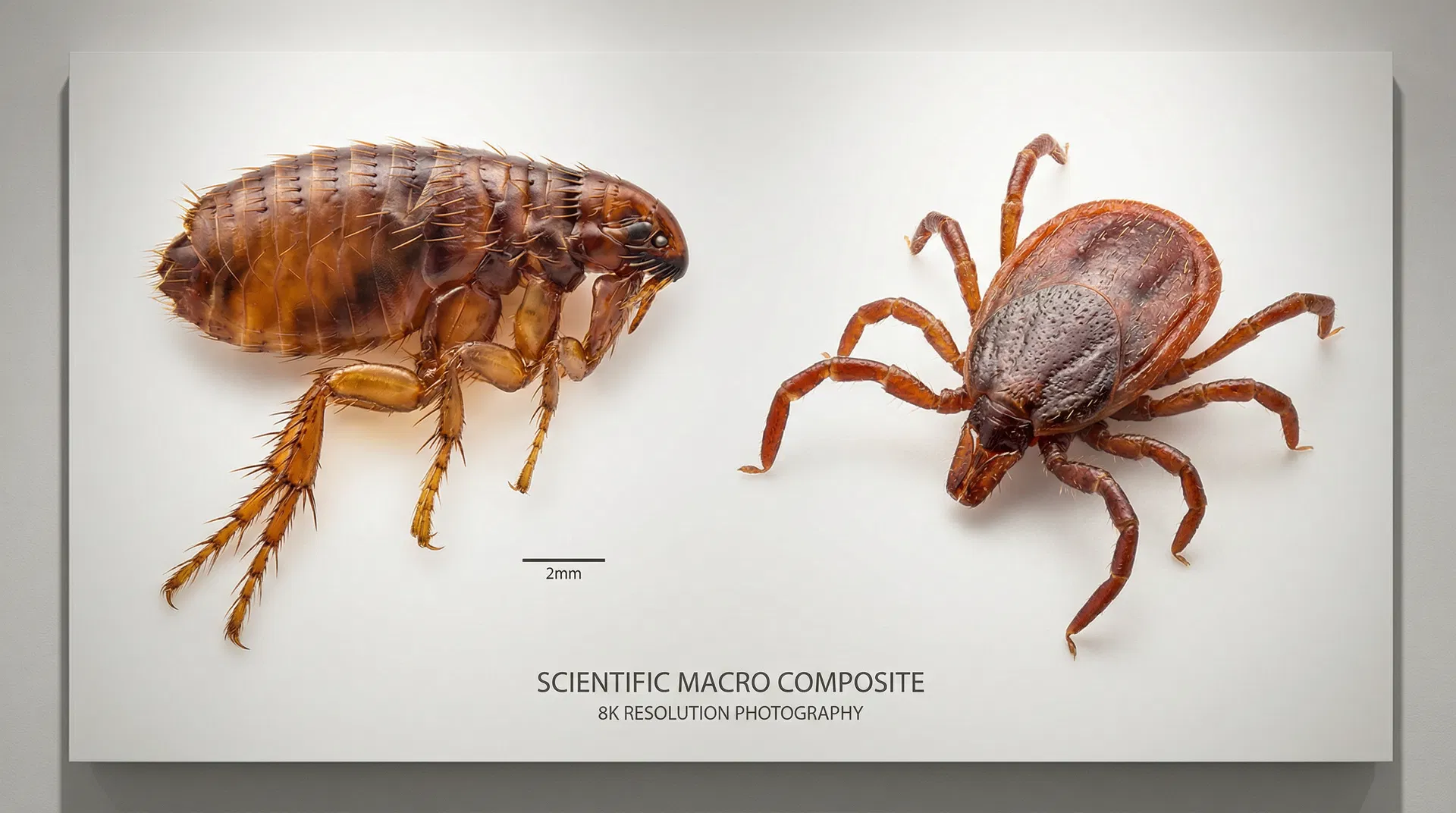
The most common flea species in South Florida and worldwide, representing over 90% of household infestations. Despite its name, it attacks cats, dogs, and humans indiscriminately. Its extremely flattened body allows it to move easily through animal fur. A single female can lay up to 50 eggs per day, and in Miami's ideal heat and humidity conditions, the complete egg-to-adult cycle can be completed in as little as 14 days. Eggs fall from the animal to the ground, where they develop in carpets, floor cracks, and pet beds.
Tip: If your pet scratches constantly or you see small black dots (flea feces) in their fur, act immediately. An infestation can go from 10 to 10,000 fleas in less than a month.
2. Dog Flea
Ctenocephalides canis
Size
1–4 mm
Color
Dark brown, similar to cat flea but slightly larger
Habitat
Dogs, foxes, coyotes, occasionally cats and humans
Very similar to the cat flea in appearance and behavior, though less common in Miami urban homes. It prefers dogs as its primary host but can also parasitize humans and other mammals. It is a known vector of the dog tapeworm (Dipylidium caninum), which can infect young children if they accidentally ingest an infected flea. Its life cycle is similar to the cat flea: eggs develop in the environment, not on the host.
Tip: Although dogs are the preferred host, this flea can survive weeks in the environment without a host. Always treat both the animal and the environment.
3. Sand Flea
Tunga penetrans / Siphonaptera spp.
Size
1 mm (fertilized female can grow to 1 cm)
Color
Light to dark brown
Habitat
Beaches, sandy gardens, dry sandy soils
Less common indoors but relevant in South Florida due to proximity to beaches and sandy gardens. The most dangerous species, Tunga penetrans, can burrow into human skin (especially feet) causing a condition called tungiasis. More frequently, the term refers to marine crustaceans that bite at the beach. In either case, bites produce intense allergic reactions.
Tip: When visiting Miami beaches, wear closed shoes in dry sand areas and apply repellent to feet and ankles.
South Florida Ticks: The 5 Key Species
Ticks
1. Brown Dog Tick
Rhipicephalus sanguineus
Size
3–5 mm (unfed); up to 12 mm (fed)
Color
Uniform reddish-brown; slate gray when engorged
Habitat
Kennels, homes with dogs, wall cracks, carpets
The most common tick in South Florida and the only species that can complete its entire life cycle inside a closed structure. This makes it a particularly problematic household pest. Unlike other ticks, it can survive and reproduce indoors year-round in Miami's climate. It prefers to feed on dogs at all stages (larva, nymph, and adult), but can bite humans when populations are very high. It is a vector of Rocky Mountain Spotted Fever (RMSF) and canine ehrlichiosis.
Tip: Check your dog after every outdoor outing, especially behind the ears, between toes, and in the armpit. A tick must feed for 24–48 hours to transmit diseases.
2. Lone Star Tick
Amblyomma americanum
Size
3–4 mm (unfed); up to 10 mm (fed)
Color
Reddish-brown; female has a distinctive white spot in the center of her back
Habitat
Dense vegetation, forest edges, areas with deer and wild birds
The tick that most frequently bites humans in Florida. It is very aggressive: larvae, nymphs, and adults actively seek hosts. Larvae cluster in groups of hundreds (called 'seed ticks') that can attack simultaneously. It is a vector of ehrlichiosis (HME), STARI (Lyme-like disease), and can cause red meat allergy (alpha-gal syndrome) in some bitten individuals. Active mainly from February to August.
Tip: If you find a cluster of tiny larvae (like poppy seeds) on your skin or clothing, they are lone star tick larvae. Use tape to remove them and apply DEET repellent.
3. American Dog Tick
Dermacentor variabilis
Size
5–15 mm
Color
Brown with white or silver markings on the dorsal shield
Habitat
Areas with tall vegetation, roadsides, parks
Primarily an outdoor tick that cannot survive indoors. Nymphs feed on small rodents; adults prefer dogs and humans. It is the primary vector of Rocky Mountain Spotted Fever in Florida, a potentially fatal disease if not treated promptly. It can also cause tick paralysis in dogs and children when attached near the base of the skull. Most abundant from March to September.
Tip: After outdoor activities in parks or areas with tall vegetation, check the entire body surface, especially the scalp, armpits, and groin.
4. Black-Legged Tick (Deer Tick)
Ixodes scapularis
Size
1–3 mm (nymph); 3–5 mm (adult)
Color
Orange-brown with characteristic black legs
Habitat
Forests, areas with white-tailed deer, dense vegetation
Known primarily as the vector of Lyme disease. In Florida, Lyme cases are less frequent than in the northeastern US because local ticks mainly feed on lizards and reptiles (which are not reservoirs of Borrelia burgdorferi). However, it also transmits babesiosis and anaplasmosis. Nymphs are extremely small (poppy seed size) and difficult to detect, increasing transmission risk.
Tip: Nymphs of this tick are so small they often go unnoticed. Shower within 2 hours of outdoor activities to detect them before they attach.
5. Gulf Coast Tick
Amblyomma maculatum
Size
4–6 mm
Color
Brown with white ornamentation on the shield
Habitat
Grasslands, coastal areas, zones with livestock and wild birds
Prevalent in southeastern states, including South Florida. Nymphs feed on birds and small rodents; adults prefer large mammals like deer and livestock, though they also bite humans. It is a vector of Rickettsia parkeri, a disease similar to Rocky Mountain Spotted Fever but generally less severe. Adults are most common from March to September.
Tip: This tick is common in rural and coastal areas of South Florida. When doing outdoor activities in these areas, wear light-colored clothing to spot ticks more easily.
Why South Florida is a Flea and Tick Paradise
Miami's subtropical climate creates perfect conditions for fleas and ticks year-round. Temperatures that rarely drop below 60°F in winter, combined with relative humidity exceeding 70% for much of the year, eliminate the climatic factors that normally control these populations in other states.
Fleas are especially prolific in Miami: under optimal heat and humidity conditions, a single female can produce up to 50 eggs daily, and the complete cycle can be completed in 14 days. This means an infestation can grow exponentially in weeks. Summer rains (May to October) increase soil moisture, accelerating the development of larvae and pupae in gardens and yards.
South Florida's abundant wildlife—including raccoons, opossums, deer, coyotes, and a wide variety of birds—provides constant tick reservoirs that can then transfer to domestic pets and humans. Miami's urban parks, canals, and areas with dense vegetation are high tick concentration points.
Diseases and Health Risks: More Serious Than You Think
Rocky Mountain Spotted Fever (RMSF)
Transmitted by the American dog tick and brown dog tick. It is the most serious tick-borne disease in the US, with a 20–25% mortality rate in untreated cases. Symptoms include high fever, severe headache, red spotted rash, and muscle pain. Requires immediate antibiotic treatment.
Ehrlichiosis and Anaplasmosis
Transmitted by the lone star tick and black-legged tick, respectively. They cause fever, headache, extreme fatigue, nausea, and confusion. Can be serious in elderly or immunocompromised individuals. Respond well to doxycycline if diagnosed early.
Lyme Disease
Although less common in Florida than in the northeastern US, it can occur. The characteristic 'bull's eye' rash appears in only 60–80% of cases. Late symptoms include arthritis, neurological, and cardiac problems. Early diagnosis is crucial to avoid chronic complications.
Flea Allergy Dermatitis (FAD)
The most common cause of dermatitis in dogs and cats in South Florida. A single flea bite can trigger a severe allergic reaction in sensitized animals, causing intense itching, hair loss, and secondary skin lesions. It can also affect humans, especially children.
Murine Typhus
Transmitted by fleas infected from rats and opossums. Present in South Florida, especially in areas with high rodent density. Causes fever, headache, skin rash, and general malaise. Generally not fatal but may require hospitalization.
Alpha-Gal Syndrome (Red Meat Allergy)
A little-known consequence of the lone star tick bite. It can cause allergy to red meat (beef, pork, lamb) and dairy products in bitten individuals. Symptoms appear 3–6 hours after consuming red meat and include hives, nausea, and in severe cases, anaphylaxis.
Cat flea (left) and brown dog tick (right): the two most common pests in South Florida homes
5 Infestation Signs You Shouldn't Ignore
Your pet constantly scratches, bites, or licks itself
The most obvious sign of fleas. If your dog or cat can't stop scratching, especially at the base of the tail, abdomen, and neck, they probably have fleas. Look for small black dots (flea feces) in their fur by running a fine comb over white paper.
Bites on ankles and legs
Fleas jump up to 12 inches high and prefer to bite ankles and lower legs. Bites appear in groups of 3 or in a straight line, with a central red dot surrounded by a lighter halo. They are intensely itchy.
Dark spots on carpets and upholstery
Flea dirt looks like small black pepper grains on carpets, pet beds, and upholstery. To confirm it's flea feces and not regular dirt, place it on wet paper: if it dissolves red (from digested blood), it's flea feces.
Ticks attached to pets or people
Ticks attach firmly to skin and can go unnoticed for days. Check your pets after every outdoor outing, especially behind the ears, between toes, in the armpit, and around the collar. On humans, check scalp, nape, armpits, and groin.
Pets with anemia or unexplained weight loss
A severe flea infestation can cause anemia, especially in puppies, kittens, and small animals. Symptoms include pale gums, extreme lethargy, weight loss, and weakness. In severe cases it can be fatal. If your pet shows these symptoms, consult a veterinarian immediately.
16 Practical Tips to Eliminate and Prevent Fleas and Ticks
Effective flea and tick control requires a comprehensive approach that simultaneously treats pets, the home interior, and the exterior. Treating only one of these three fronts guarantees failure.
Pet Protection
- ✓
Apply monthly preventive flea and tick treatment to ALL household pets, even those that don't go outdoors (fleas can enter on clothing or shoes).
- ✓
Consult your veterinarian about the most appropriate product: there are topical options (Frontline, Advantage), oral (NexGard, Bravecto), and collars (Seresto). In Miami, long-lasting products are more effective.
- ✓
Bathe your pets regularly with anti-flea shampoo and use a fine-toothed comb to detect fleas and flea dirt.
- ✓
Check your pet with a fine comb after every walk, especially if they were in areas with tall vegetation or in contact with other animals.
Indoor Home Control
- ✓
Vacuum carpets, upholstery, floor cracks, and pet beds DAILY during an active infestation. Fleas in pupal stage are resistant to insecticides but not to mechanical vacuuming.
- ✓
Wash all bedding (yours and your pets') in hot water (140°F or higher) and dry at high temperature. Repeat weekly during treatment.
- ✓
Apply an insecticide spray with IGR (insect growth regulator) on carpets, upholstery, and cracks. IGRs interrupt the flea life cycle and are safe for pets when applied correctly.
- ✓
Don't forget to treat under furniture, behind appliances, and in any area where your pet usually rests.
Outdoor Control
- ✓
Keep grass cut to less than 3 inches. Fleas and ticks prefer the shade and moisture of tall grass. Direct sunlight kills eggs and larvae.
- ✓
Remove leaf litter, wood piles, and debris where fleas and ticks shelter. Keep shrubs trimmed and away from the house.
- ✓
Apply an insecticide treatment around the garden perimeter, especially in areas where your pet rests outdoors. Products with bifenthrin or permethrin are effective.
- ✓
Install physical barriers to prevent wildlife (raccoons, opossums, deer) from entering your yard, as they are tick carriers.
Personal Protection
- ✓
Use repellent with 20–30% DEET or picaridin on exposed skin when doing outdoor activities in vegetated areas. Apply permethrin to clothing (not skin) for extra protection.
- ✓
Wear light-colored clothing when in tick areas: long pants tucked into socks and long-sleeved shirt. Ticks are more visible on light fabrics.
- ✓
Check your entire body within 2 hours of outdoor activities. Shower to remove unattached ticks. Pay special attention to scalp, nape, armpits, navel, groin, and behind knees.
- ✓
If you find an attached tick, remove it with fine-tipped tweezers: grasp it as close to the skin as possible and pull upward with firm, steady pressure. Don't crush, burn, or apply petroleum jelly. Disinfect the area and save the tick in a sealed container in case you need to identify it.
When to Call a Professional?
Flea and tick control can be managed by the homeowner in mild infestations with treated pets. However, there are situations where professional intervention is necessary and more cost-effective in the long run.
A pest control professional has access to higher concentration and persistence products than those available to consumers, and can apply treatments in hard-to-reach areas such as the crawl space, attic, and wall cracks.
- •The infestation persists after 2–3 weeks of home treatment
- •There are fleas in multiple rooms or throughout the house
- •You have no pets but still see fleas (they may have entered with wildlife or on clothing)
- •You repeatedly find ticks in your yard or on your family
- •Your pet develops signs of anemia (pale gums, lethargy)
- •A family member develops symptoms of tick-borne disease (fever, rash, severe headache)
- •You have young children, elderly adults, or immunocompromised individuals at home
A certified technician will apply a comprehensive treatment including residual insecticides, growth regulators (IGR), outdoor treatment, and specific recommendations for your situation. At Harpoon Pro we use products safe for pets and people when re-entry instructions are followed.
Frequently Asked Questions
How long does it take to eliminate a flea infestation?+
A moderate infestation takes 4 to 8 weeks to completely eliminate with comprehensive treatment. This is because flea pupae are resistant to insecticides and must hatch before being killed. Treatment must include all pets, the home interior, and the exterior. If you only treat the pet, the infestation returns within 2–3 weeks.
Are flea and tick treatments safe for my children and pets?+
The professional products we use at Harpoon Pro are safe for people and pets when re-entry times are respected (generally 2–4 hours after application, once the product is dry). IGRs (insect growth regulators) are especially safe because they act specifically on insects and have no significant toxicity for mammals. We always inform our clients about waiting times before re-entering the treated area.
Can I have fleas in my home if I don't have pets?+
Yes. Fleas can enter the home through clothing, shoes, or carried by wildlife (raccoons, opossums, rats) that pass near your home. It is also common for previously pet-occupied homes to have dormant flea pupae in carpets and cracks that hatch when they detect vibrations and body heat from new residents. In Miami, this phenomenon is especially frequent.
How do I correctly remove an attached tick?+
Use fine-tipped tweezers and grasp the tick as close to the skin surface as possible. Pull upward with firm, steady pressure without twisting or jerking. Do not crush the tick, burn it, or apply petroleum jelly, alcohol, or nail polish (these methods can cause the tick to regurgitate into the wound, increasing infection risk). After removal, disinfect the area with alcohol. Save the tick in a container with alcohol in case you need to identify it. See a doctor if you develop fever, rash, or malaise within the next 30 days.
How often should I treat my pet for fleas and ticks in Miami?+
In South Florida, preventive treatment must be monthly year-round, without exceptions. Unlike northern states where winter interrupts life cycles, in Miami fleas and ticks are active all 12 months of the year. Skipping one month of treatment can be enough for an infestation to establish. Consult your veterinarian about the most appropriate product for your pet, considering their weight, age, and health condition.