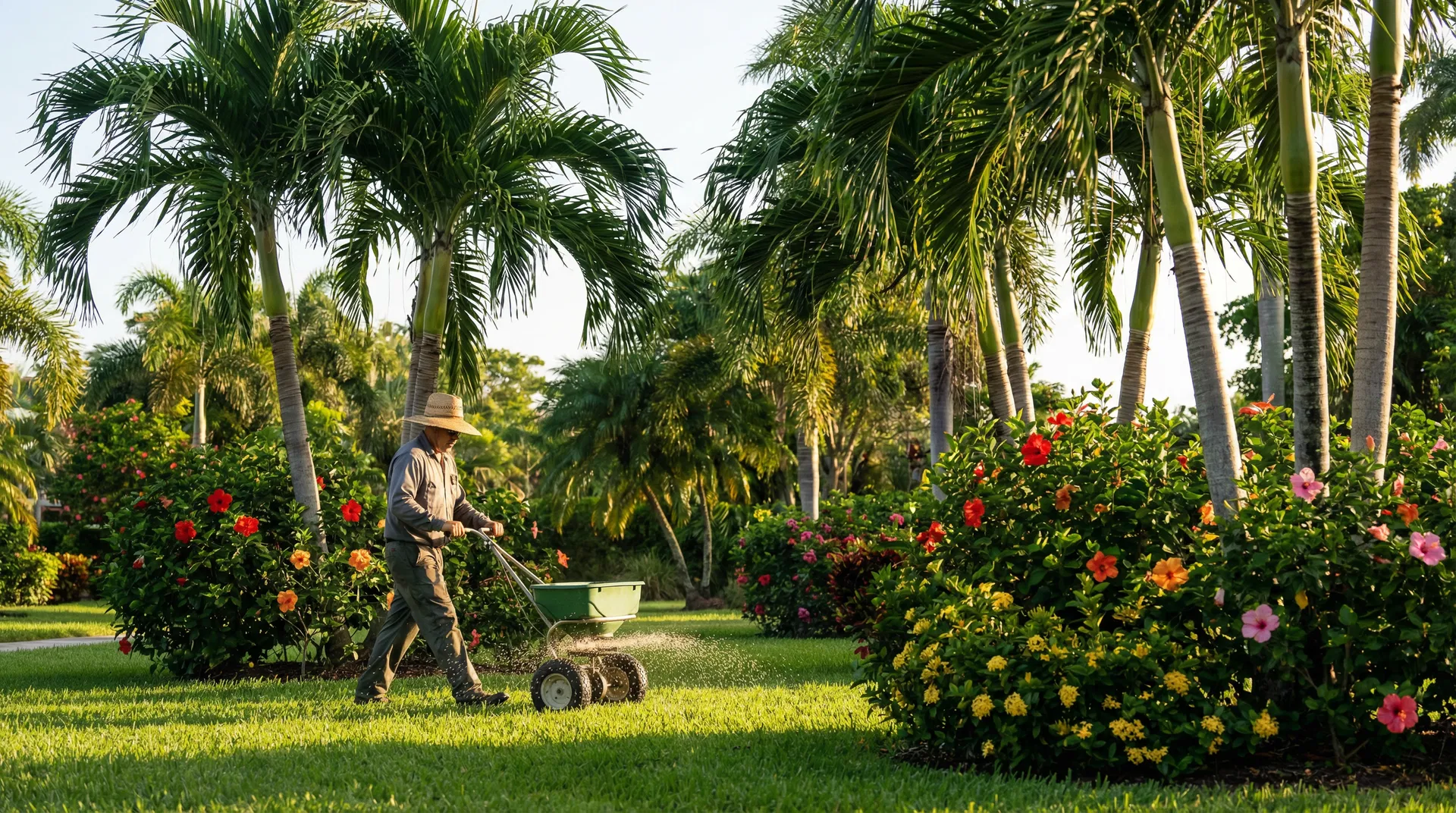
Fertilization in South Florida: Complete Guide for Lawn, Ornamental Plants & Palms
Learn when, how, and with what to fertilize each type of plant in Miami for a lush garden throughout all 12 months of the year.
South Florida is one of the most challenging places in the world for gardeners. The sandy, calcareous soil of Miami-Dade, Broward, and Palm Beach counties has virtually no nutritional value on its own: nutrients leach rapidly with tropical rains and frequent irrigation, leaving plants without food within weeks if not regularly fertilized.
Add to this Florida's "Fertilizer Ordinance," which prohibits the application of nitrogen or phosphorus fertilizers between June 1 and September 30 in many South Florida counties to protect coastal waters from algae blooms. Knowing these rules is as important as knowing which fertilizer to use.
This guide covers the three pillars of South Florida landscaping: lawn, ornamental plants, and palms. Each has specific nutritional needs, different schedules, and fertilizers recommended by the University of Florida (UF/IFAS), the most recognized scientific authority on tropical horticulture in the state.
South Florida Soil: Why You Need to Fertilize More
The predominant soil in South Florida is calcareous sand with alkaline pH (7.5–8.5), which creates two main problems: first, sand doesn't retain nutrients — rainwater and irrigation wash them to deep layers before roots can absorb them. Second, the high pH makes many micronutrients (iron, manganese, zinc) insoluble and unavailable to plants, even if present in the soil.
The result is that plants in South Florida need more frequent fertilization than in other regions, and controlled-release (slow-release) fertilizers must be used to compensate for leaching. Fast-release fertilizers, though cheaper, are lost within days during summer rains.
Before fertilizing any plant, the ideal approach is to conduct a soil analysis through your county's UF/IFAS extension office. A basic analysis costs between $10 and $20 and will tell you exactly which nutrients are lacking, avoiding unnecessary expenses and the risk of over-fertilization.
Lawn Fertilization: The Most Common Species in Miami
St. Augustine (Floratam)
The most popular lawn in South Florida. Tolerates heat and humidity but is demanding in nutrients.
NPK
15-0-15 or 16-0-8
Frequency
4–6 times per year (outside blackout period)
Rate
1 pound of nitrogen per 1,000 square feet per application
Needs chelated iron to maintain deep green color. Susceptible to chinch bugs when over-fertilized with nitrogen.
Tip: Fertilize in March, May, August (if ordinance allows in your area), October, and December. Always use slow-release fertilizer (50% or more slow-release).
Bahia Grass
More drought-resistant and lower maintenance. Common in suburban areas and large properties.
NPK
16-0-8 or 15-0-15
Frequency
3–4 times per year
Rate
1 pound of nitrogen per 1,000 square feet
Tolerates poor soils better than St. Augustine. Responds well to iron-containing fertilizers to correct yellowing.
Tip: Fertilize in April, July, and October. Avoid excess nitrogen that promotes rapid growth and increases mowing needs.
Zoysia
Dense, traffic-resistant lawn. Grows slower but requires less maintenance.
NPK
15-0-15 or 16-4-8
Frequency
3–4 times per year
Rate
0.5–1 pound of nitrogen per 1,000 square feet
Tolerates partial shade better than St. Augustine. Less susceptible to pests when properly fertilized.
Tip: Apply fertilizer when the lawn is actively growing (spring and summer). Avoid fertilizing in winter.
Ornamental Plant Fertilization: By Plant Type
Flowering Shrubs (Hibiscus, Ixora, Bougainvillea, Plumbago)
NPK
2-0-10 or 7-0-7
Frequency
Every 2–3 months (spring, summer, fall)
Flowering shrubs need high potassium to promote blooming. Phosphorus has been removed from most Florida fertilizers due to environmental regulations; compensate with bone meal or monthly liquid 20-20-20 fertilizer.
Tip: To maximize hibiscus and bougainvillea blooming, apply high-potassium (K) fertilizer and supplement with liquid fertilizer every 2 weeks during the blooming season.
Green Shrubs (Croton, Sedum, Ficus, Areca)
NPK
7-0-7 or 8-0-8
Frequency
Every 3 months
Green shrubs need nitrogen to maintain dense, glossy foliage. Croton also needs micronutrients (iron, manganese) to maintain its vibrant colors.
Tip: Apply fertilizer at the drip line, not at the trunk base. Water lightly after applying to activate the granules.
Azaleas and Gardenias
NPK
7-0-8 (acid-loving formulation)
Frequency
Spring (after blooming) and mid-summer
Require acidic soil (pH 5.5–6.5). In Miami's alkaline soil, they need acidifying fertilizer and sulfur to lower pH. Never fertilize after October to avoid stimulating growth that could be damaged by cold.
Tip: Apply granular sulfur to the soil twice a year to maintain low pH. Yellow leaves with green veins indicate iron deficiency due to high pH.
Shade and Foliage Plants (Ferns, Caladiums, Bromeliads)
NPK
Osmocote 14-14-14 or Nutricote 13-13-13 (controlled release)
Frequency
Every 3–4 months
Shade plants need controlled-release fertilizers that won't burn delicate foliage. Bromeliads absorb nutrients primarily through the central cup (tank), not through roots.
Tip: For bromeliads, apply diluted liquid fertilizer directly into the center of the plant. For ferns, use slow-release granular fertilizer sprinkled on the substrate.
Palm Fertilization: The Definitive UF/IFAS Guide
Palms are the most misunderstood plants when it comes to fertilization in South Florida. Many homeowners use generic or lawn fertilizers on their palms, which can cause serious deficiencies and accelerate their deterioration. The University of Florida (UF/IFAS) has a specific, well-documented recommendation for landscape palms.
The recommended formula is 8-2-12 + 4 Mg (8% nitrogen, 2% phosphorus, 12% potassium, 4% magnesium), applied at 1.5 pounds per 100 square feet of palm canopy area. All nutrients must be slow-release (polymer-coated) — palm fertilizers with fast-release nutrients leach before roots can absorb them, especially during summer rains.
UF/IFAS Recommended Formula:
8-2-12 + 4Mg
Apply palm fertilizer 4 times per year: January, April, July, and October. Always use the 8-2-12 + 4Mg formula with controlled-release nutrients. Apply evenly under the palm canopy, not at the trunk base.
Potassium (K) Deficiency — The Most Common
Symptoms
Older leaves with translucent or necrotic orange-brown spots, starting at the edges. Leaves look 'burned' or 'fried'.
Treatment
Apply slow-release potassium sulfate (polymer-coated) to the soil. Do NOT use potassium chloride (KCl) — it's toxic to palms. Recovery can take 1–2 years.
Tip: Potassium deficiency is irreversible in affected leaves. Only new leaves will show improvement. Never cut affected leaves until completely dead — they continue supplying potassium to the palm.
Magnesium (Mg) Deficiency
Symptoms
Wide yellow band on the edges of older leaves, with the leaf center remaining green. Known as 'V deficiency'.
Treatment
Apply kieserite (granular magnesium sulfate) to the soil. Avoid soluble magnesium sulfate (Epsom salt) — it leaches too quickly in sandy soils.
Tip: Magnesium deficiency is cosmetic in early stages but can weaken the palm over time. Responds well to treatment if detected early.
Manganese (Mn) Deficiency
Symptoms
New (emerging) leaves with 'frizzled' appearance — wrinkled, necrotic, with yellow and brown streaks. Youngest leaves are most affected.
Treatment
Apply manganese sulfate to the soil. In Miami's alkaline soils, manganese becomes insoluble — may need foliar applications of chelated manganese sulfate.
Tip: Manganese deficiency is common in royal palms and areca palms in Miami. If the growth point (spear) dies, the palm cannot recover. Act quickly.
Iron (Fe) Deficiency
Symptoms
New yellow leaves with green veins (interveinal chlorosis). Common in palms planted in very high pH soils.
Treatment
Apply ferrous sulfate to the soil or iron chelate (EDTA or EDDHA). Foliar applications are temporary — soil treatment is more effective long-term.
Tip: Before treating iron deficiency, check soil pH. If pH is above 7.5, iron won't be available regardless of how much you apply. Acidify the soil first.
South Florida Fertilization Calendar
January – February
Fertilize palms with 8-2-12 + 4Mg. Apply slow-release fertilizer to ornamental shrubs and trees. Avoid fertilizing lawn — low temperatures reduce absorption.
March – May
Main fertilization season. Apply lawn fertilizer (15-0-15 or 16-0-8) before June 1st. Fertilize all flowering and ornamental shrubs. Second palm application in April.
June – September
BLACKOUT PERIOD in most South Florida counties. Prohibited to apply nitrogen or phosphorus fertilizers to lawns and gardens. You may apply iron, micronutrients, and certified organic fertilizers.
October – November
Resume lawn fertilization (October 1st). Fertilize shrubs and ornamentals. Third palm application in October. Last chance to fertilize azaleas and gardenias (not after October).
December
Fourth palm application. Light lawn fertilization if temperatures stay above 60°F. Avoid stimulating new growth that could be damaged by cold.
Common Mistakes to Avoid
❌ Fertilizing during the blackout period (June–September)
It's illegal in many South Florida counties and can result in fines. Excess nitrogen and phosphorus contaminate water bodies and promote algae blooms.
❌ Using lawn fertilizer on palms
Lawn fertilizers have incorrect nutrient ratios for palms and can cause potassium and magnesium deficiencies long-term.
❌ Applying fertilizer at the trunk base
Absorbing roots are at the drip line, not at the base. Applying at the base can burn surface roots and waste fertilizer.
❌ Using fast-release fertilizers in summer
South Florida's tropical rains leach fast-release fertilizers within 24–48 hours. Only slow-release fertilizers are effective during the rainy season.
❌ Cutting yellow palm leaves with deficiencies
Leaves with potassium or magnesium deficiency continue supplying these nutrients to the palm while partially green. Cutting them prematurely worsens the deficiency.
❌ Over-fertilizing thinking more is better
Excess nitrogen promotes rapid, succulent growth that attracts pests (aphids, chinch bugs, thrips) and increases susceptibility to fungal diseases.
When Do You Need a Professional?
While basic fertilization can be done without help, there are situations where a certified landscaping professional is needed to diagnose and treat complex nutritional problems.
- •Palms with severe manganese deficiency symptoms (dead or 'frizzled' emerging leaves)
- •Multiple plants with chlorosis (yellowing) that doesn't respond to standard treatments
- •Soil with extremely high pH (>8.0) requiring special amendments
- •Gardens larger than half an acre requiring a professional fertilization program
- •Mature ornamental trees with signs of chronic nutritional stress
Harpoon Pro offers plant fertilization and nutrition services as part of our garden maintenance programs. Our certified technicians can perform soil analyses and design a customized fertilization program for your property.