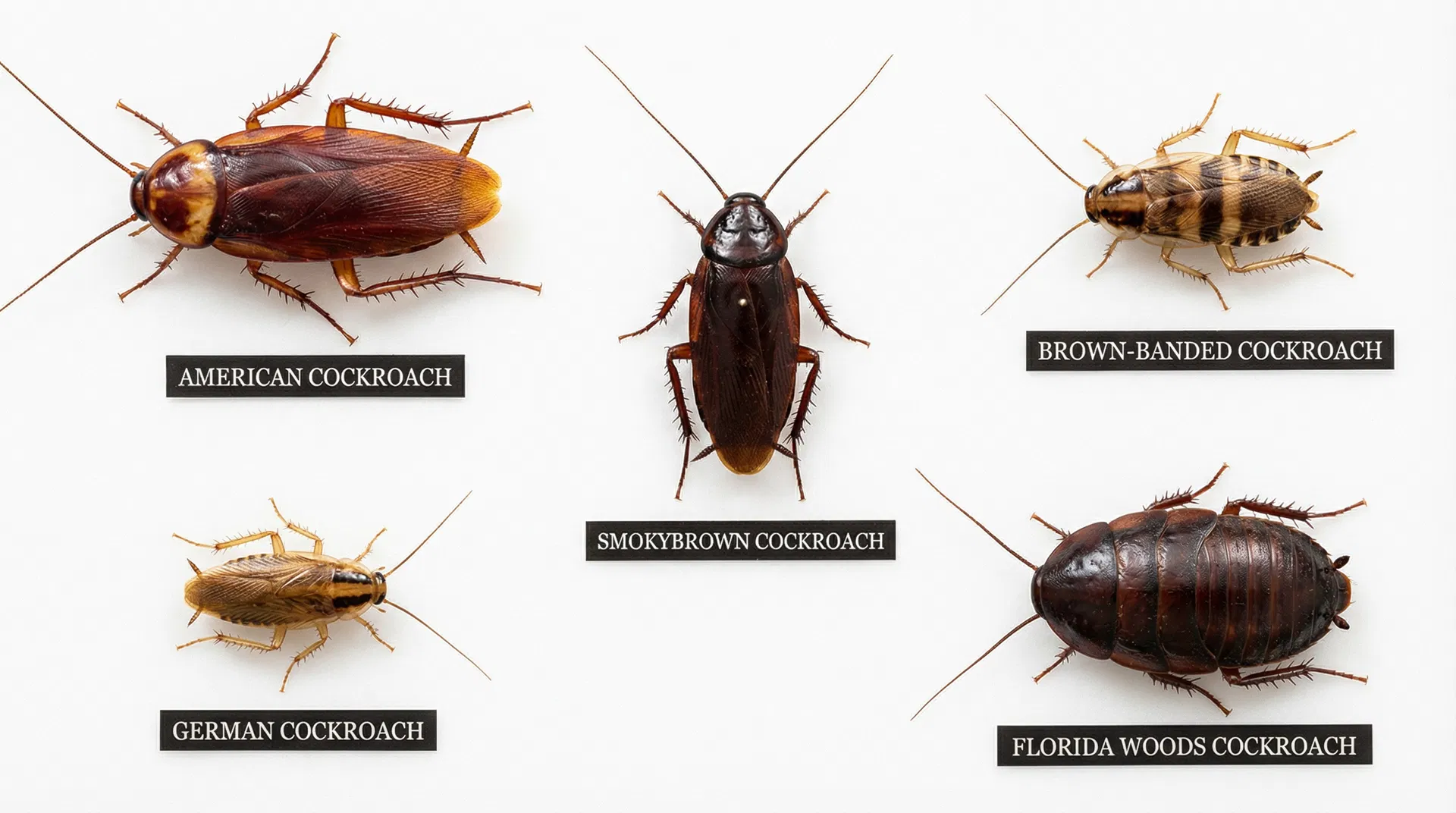
Cockroaches in South Florida: Complete Identification and Control Guide
Learn about the 5 most dangerous species in Miami, their infestation signs, and the practical tips that actually work to eliminate them.
South Florida, and especially Miami, offers ideal conditions for cockroaches to thrive year-round. The subtropical heat, persistent humidity, and abundance of food and water sources make every home an attractive destination for these pests. Unlike colder states where winter naturally eliminates populations, in Miami cockroaches never stop.
What many homeowners don't know is that not all cockroaches are the same: each species has different behaviors, habitats, and vulnerabilities. Knowing which one you're dealing with is the first step to eliminating them effectively and permanently.
The 5 Most Common Species in Miami and South Florida
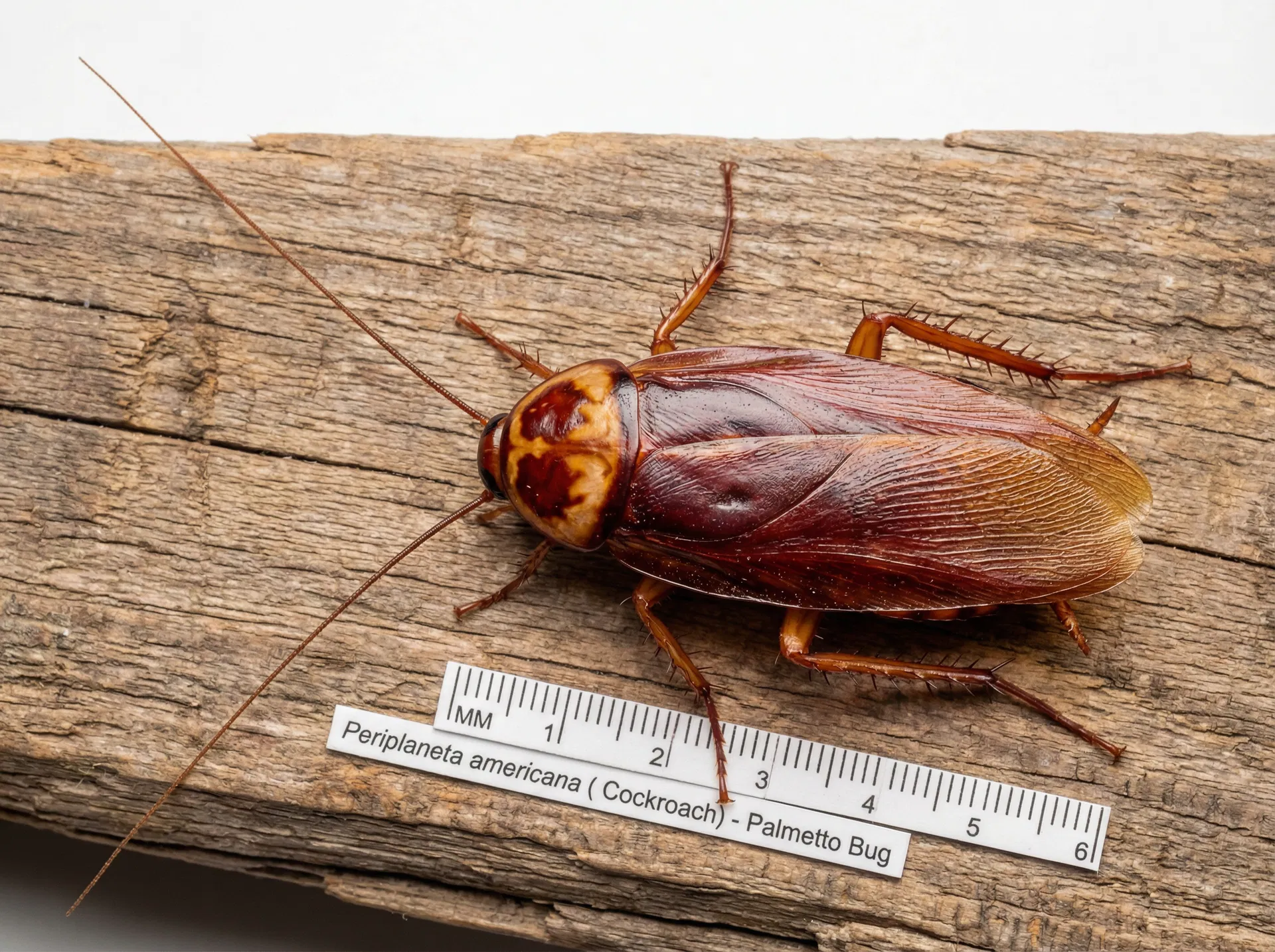
1. American Cockroach (Palmetto Bug)
Periplaneta americana
Size
1.5–2 inches (4–5 cm)
Color
Reddish-brown with yellowish band on head
Habitat
Sewers, basements, attics, humid outdoor areas
The largest cockroach and the most frequently reported in South Florida. Despite its name, it's native to Africa. It prefers to live outdoors—in sewers, storm drains, garden mulch, and palm trees—but enters homes looking for food and water, especially during heavy rains or droughts. It can fly short distances and is very fast. A female produces up to 150 eggs per year.
Tip: If you occasionally see a single American cockroach, it probably came in from outside. If you see them several times a week, there may be a plumbing entry point.
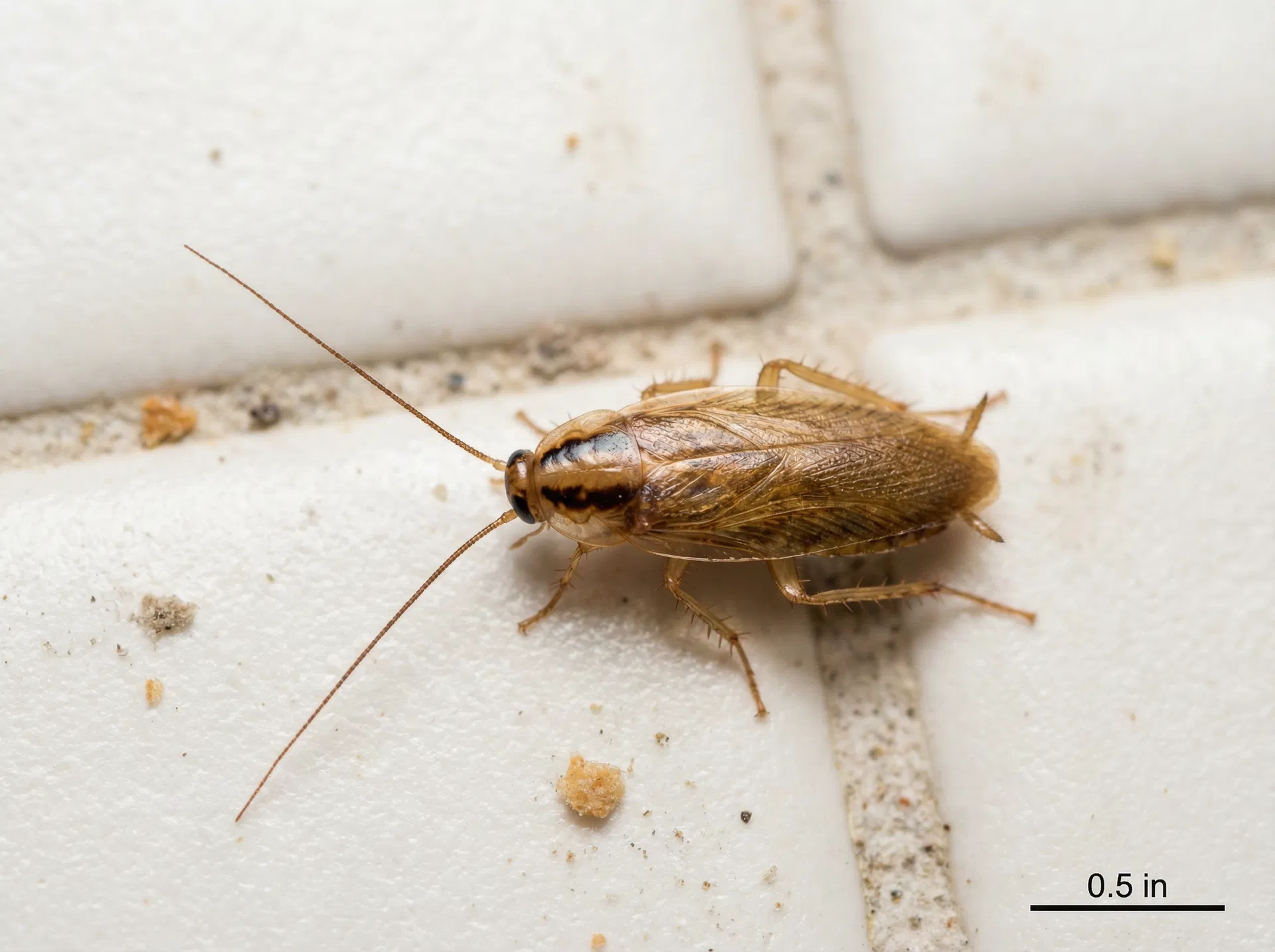
2. German Cockroach
Blattella germanica
Size
0.5 inches (1.3–1.6 cm)
Color
Light brown with two dark parallel stripes on the thorax
Habitat
Kitchens, bathrooms, appliances, restaurants
Considered the most problematic indoor species. Unlike the American cockroach, the German cockroach lives and reproduces exclusively inside structures. It concentrates near heat and humidity: behind refrigerators, under sinks, in dishwasher motors, and on cabinet hinges. Its reproduction rate is alarming: a single female can generate up to 30,000 descendants in a year. Home remedies are rarely sufficient to eliminate an established infestation.
Tip: If you see a German cockroach during the day, it's a sign the colony is overcrowded. Act immediately.
3. Smokybrown Cockroach
Periplaneta fuliginosa
Size
1.2–1.5 inches (3–4 cm)
Color
Uniform dark brown, glossy
Habitat
Attics, gutters, tree holes, mulch areas
A powerful flier and highly attracted to outdoor lights. Nests primarily outdoors—in attics, gutters, tree holes, and areas with wet mulch—but enters homes through attic vents, soffits, and poorly sealed doors. More common in residential areas with dense vegetation.
Tip: Turn off unnecessary outdoor lights at night and seal attic vents to reduce their presence.
4. Brown-Banded Cockroach
Supella longipalpa
Size
0.5 inches (1.3 cm)
Color
Brown with light transverse bands
Habitat
Living rooms, bedrooms, inside electronics and furniture
Unlike other species, it doesn't need much humidity. It prefers warm, dry areas: behind pictures, inside electronics, in closets, and on top of cabinets. Its behavior makes it difficult to detect because it doesn't concentrate in kitchens and bathrooms like others. Infestations are usually discovered late.
Tip: Check behind pictures, TVs, and high in closets if you suspect this species.
5. Florida Woods Cockroach (Stinking Cockroach)
Eurycotis floridana
Size
1.5 inches (3–4 cm)
Color
Dark brown to black, no functional wings
Habitat
Wood piles, mulch, underground spaces
Also known as the 'stinking cockroach' for the foul-smelling liquid it releases when threatened. It's primarily an outdoor species that lives in wood piles, mulch, and rotting logs. It rarely infests homes but can accidentally enter with firewood or through damp spaces.
Tip: Keep firewood away from the house and check garden mulch periodically.
Why Miami is a Cockroach Paradise
Miami's subtropical climate creates perfect conditions for cockroaches year-round. Temperatures that rarely drop below 60°F in winter, combined with relative humidity exceeding 70% for much of the year, eliminate the climatic factors that normally control cockroach populations in other states.
Summer rains (May to October) are especially problematic: floods displace colonies from sewers and drains into homes. During winter droughts, cockroaches seek water sources inside structures. In Miami, there is no "off season" for cockroaches.
Miami's urban density also contributes: apartment buildings, restaurants, and interconnected sewer systems create perfect highways for cockroaches to move between properties.
Health Risks: More Serious Than You Think
Food Contamination
Cockroaches carry bacteria on their bodies including Salmonella, E. coli O157:H7, Staphylococcus aureus, and Listeria. They contaminate kitchen surfaces, utensils, and food simply by walking on them, defecating and partially vomiting while feeding.
Allergies and Asthma
Proteins present in cockroach feces, shed skins, and saliva are potent allergens. According to the American Lung Association, cockroaches are one of the leading causes of asthma in children living in urban areas. In Miami, where childhood asthma is prevalent, this risk is especially relevant.
Communicable Diseases
Cockroaches can carry pathogens causing salmonellosis, dysentery, cholera, typhoid fever, and gastroenteritis. Scientific studies have found that cockroaches can harbor up to 33 different types of bacteria in their bodies.
Property Damage
Cockroaches gnaw on paper, fabric, leather, and plastic. They can damage books, clothing, upholstery, and even electrical insulation. Their excrement permanently stains surfaces and generates persistent odors that are difficult to eliminate.
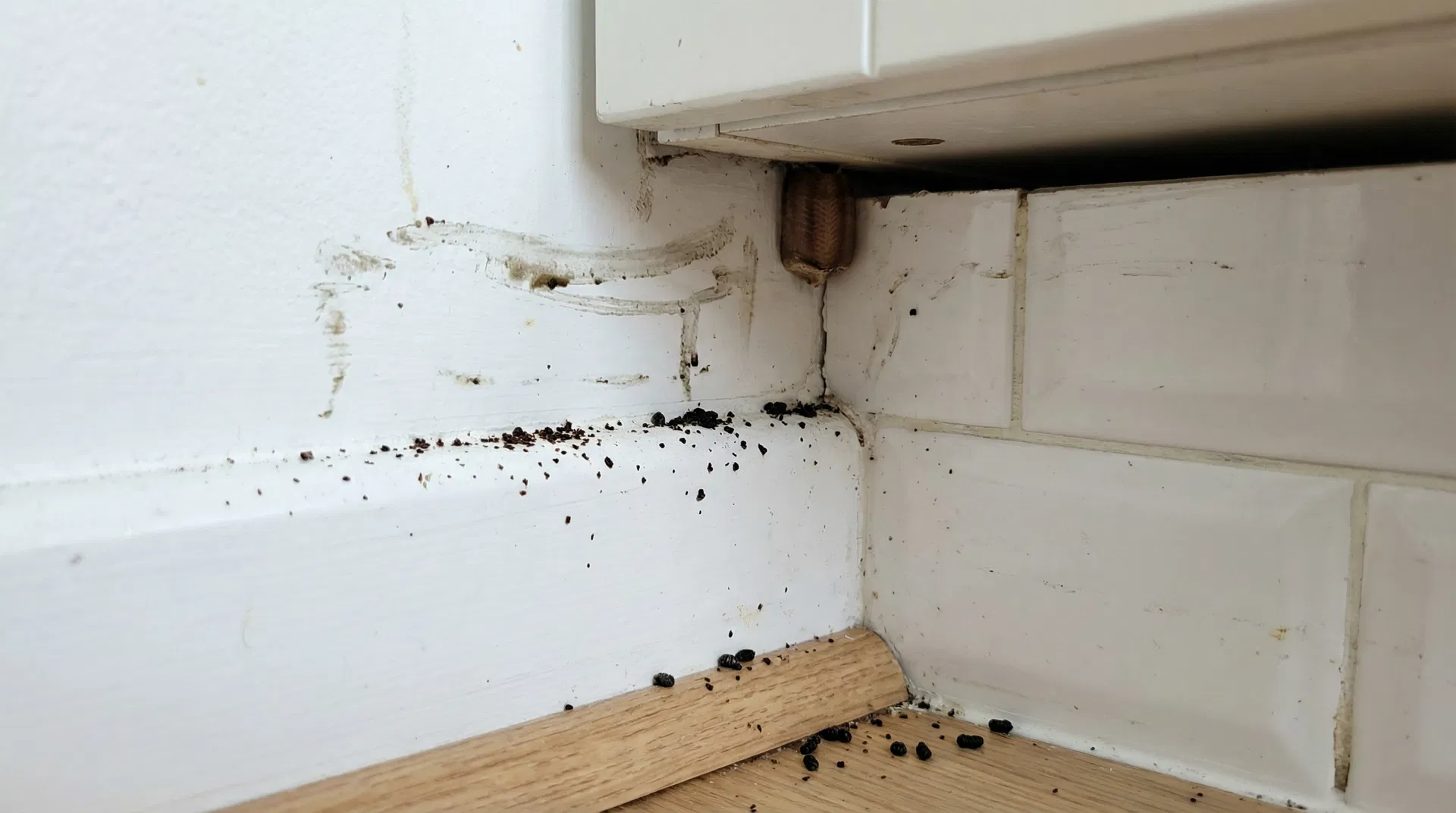
Typical infestation signs: droppings, oothecae, and grease marks in kitchen corners
5 Infestation Signs You Shouldn't Ignore
Droppings that look like black pepper
Small dark spots near cabinets, behind appliances, or along baseboards. Small cockroaches (German) leave coffee-ground-like droppings; large ones (American) leave small cylinders.
Egg capsules (oothecae)
Oval brown capsules about 8mm, similar to medicine capsules. Each can contain between 15 and 50 embryos. Look for them in corners, under the sink, and in pantry corners.
Persistent musty odor
Cockroaches produce pheromones that generate a musty, unpleasant odor. If the smell persists after cleaning, it may signal an established colony behind walls or under appliances.
Cockroaches visible during the day
Cockroaches are nocturnal. If you see them during the day, it means the colony is overcrowded and they're being forced out looking for space and food. This is a sign of a serious infestation.
Grease marks on walls and baseboards
Moving repeatedly along the same paths, cockroaches leave oily stains and dark marks along low walls, baseboards, and near appliances.
15 Practical Tips to Control Cockroaches in Miami
Prevention is the first line of defense. These tips, based on integrated pest management best practices, are specifically adapted for South Florida's climate conditions:
Food and Water Control
- ✓
Store all food in airtight glass or thick plastic containers. Cardboard and thin plastic bags won't stop cockroaches.
- ✓
Remove pet food and water bowls overnight. Pet food is one of the main attractants.
- ✓
Empty the trash daily and use containers with tight-fitting lids. Even small food residues are enough to attract them.
- ✓
Clean spills immediately, especially under and behind appliances. These forgotten areas become reliable food sources.
- ✓
Pour diluted vinegar or bleach down drains before traveling or during rainy season. Drains are a known entry point.
Sealing Entry Points
- ✓
Seal cracks in baseboards, door frames, and around pipes with silicone. Cockroaches can pass through spaces as thin as a coin.
- ✓
Install weather stripping on all doors and screens on attic vents and drains. These are the main entry routes for flying species.
- ✓
Use expanding foam around exterior pipes and utility lines. These spaces lead directly into walls.
- ✓
Check and repair the plumbing system regularly. Cast iron pipes in old homes deteriorate and create entry points from the sewer.
Humidity Control
- ✓
Use dehumidifiers in garages, bathrooms, and laundry rooms. Cockroaches need water more than food.
- ✓
Fix plumbing leaks immediately, even the smallest ones. Dripping under the sink or washer is a magnet for German cockroaches.
- ✓
Make sure the air conditioning works properly. High indoor humidity promotes reproduction.
DIY Defense Strategies
- ✓
Apply boric acid powder behind large appliances and in attics. It kills cockroaches slowly and is effective for hidden areas. Keep children and pets away.
- ✓
Spread food-grade diatomaceous earth under appliances and along baseboards. Safe for people and pets but lethal to cockroaches by dehydrating them.
- ✓
Spray peppermint or eucalyptus oil diluted in water around windows, baseboards, and problem areas. Cockroaches avoid strong scents.
- ✓
Place sticky traps in high-risk areas (under the sink, behind the refrigerator) to monitor activity and detect early infestations.
When to Call a Professional?
Home remedies are useful for prevention and very mild infestations, but have important limitations. The German cockroach, in particular, requires professional treatment in almost all cases due to its reproduction speed and resistance to many over-the-counter insecticides.
Call a professional if:
- •You see cockroaches during the day (sign of overcrowding)
- •You find oothecae (egg capsules) in multiple places
- •Home remedies show no improvement after 2 weeks
- •There's a persistent musty odor that doesn't go away with cleaning
- •You live in an apartment building (cockroaches move between units)
- •You have children, elderly adults, or people with asthma at home
A certified professional will use Integrated Pest Management (IPM) techniques that combine gel baits, residual insecticides, wall void treatments, and entry point sealing for a lasting solution.